




Why model your network?

A digital map tells you what you did. A digital twin tells you what's true — right now, to everyone. That difference is where the cost, the speed and the future of your network live.

How we got here?

For decades the industry digitized: paper workflows became shapefiles, CAD files, databases and spreadsheets. Each tool modelled one slice of the network well, and it made sense — one team owned ducts, another owned splicing, each with its own workflow and its own tool. But a single source of truth stayed out of reach. People call the result “chair-swiveling”: to understand one network, you consult a dozen inventories.


Why it hurts

The cost shows up at the worst possible time. During an outage, teams scramble to assemble datasets and argue about the data — how old is this, who maintained it, can we trust this field, how should we read it? — precisely when speed matters most. And because as-built backlogs run six months, sometimes four years, the strategic maps leadership relies on are simply out of date. Sales can’t move faster, time-to-repair stays high, and truck rolls pile up — because the only way to be sure what’s in the ground or in the air is to send someone to check.

Map vs twin: the four maturity levels

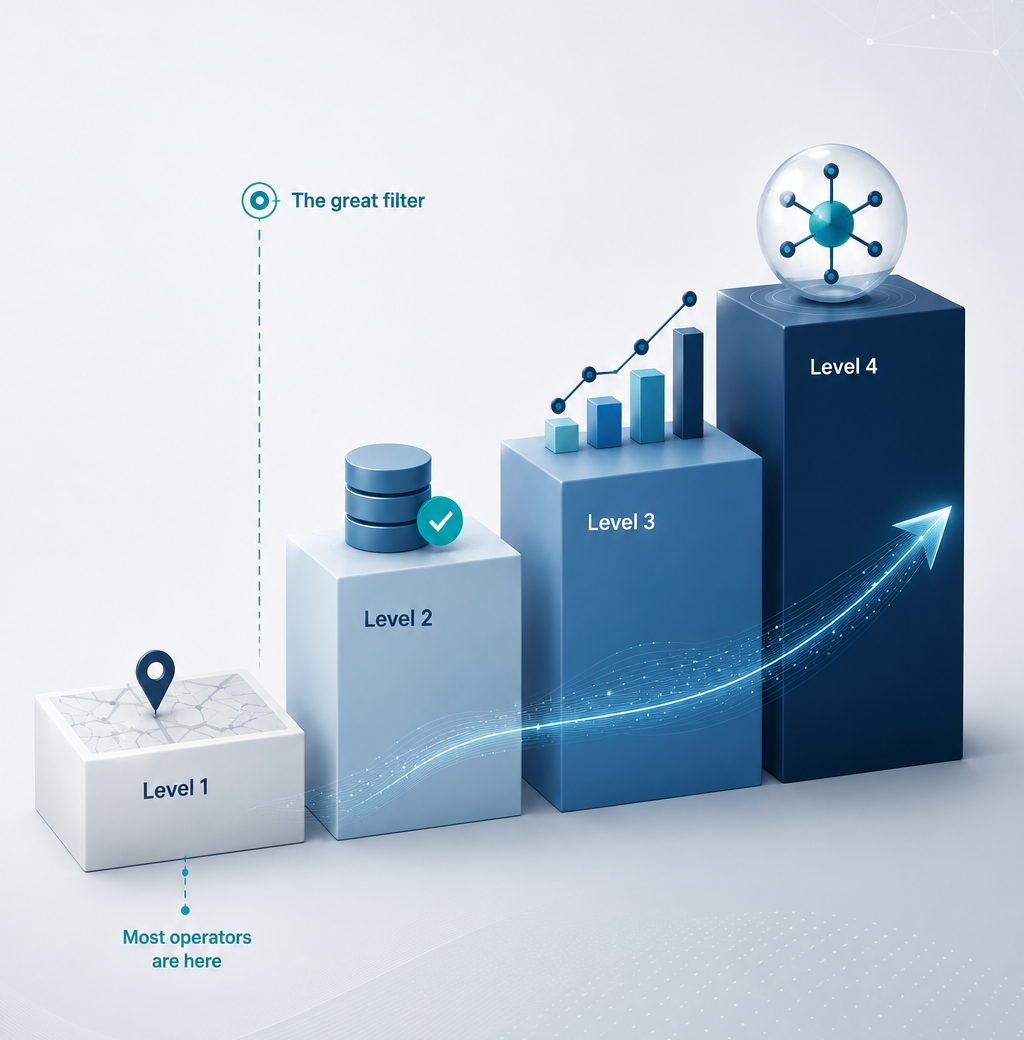
Merkator's Luc De Heyn frames the journey as four levels — and most operators are stuck on the first.

Level 1 · The Digital Map

A GIS that documents what’s been done — chasing an as-built backlog, ignored by planning and design, siloed from daily work. Where most operators are today.

Level 2 · The True Digital Twin

The whole organisation makes decisions from the same accurate, complete, up-to-date data. Design, build and operations live in the same place; the silos disappear. The hardest, most valuable jump.

Level 3 · The Intelligent Twin

Trustworthy data lets you layer history and spot trends — outage hotspots, capacity bottlenecks — before they bite.

Level 4 · The Autonomous Twin

AI agents act on the twin — preparing work orders, and eventually orchestrating a network that heals itself.

Don’t build on mud

The temptation is to leap straight from a digital map to AI. But bolt automation onto messy data and you simply automate the chaos — losing money and, worse, the organisation’s trust in the technology. The real return is in crossing from Level 1 to Level 2: getting the foundation right first. You can use AI here too — not to run the network, but to fix it: validating as-builts, cleaning legacy data, automating field-survey ingestion.

See where your data stands →Where AI fits — and where it doesn't →

Book a demo

Merkator innovates continuously — testing new tools and building our own — and we partner with AI specialists who build the next-level use-cases. Our job is to make sure the network is modelled correctly first, so that when the AI runs, it runs on the truth.